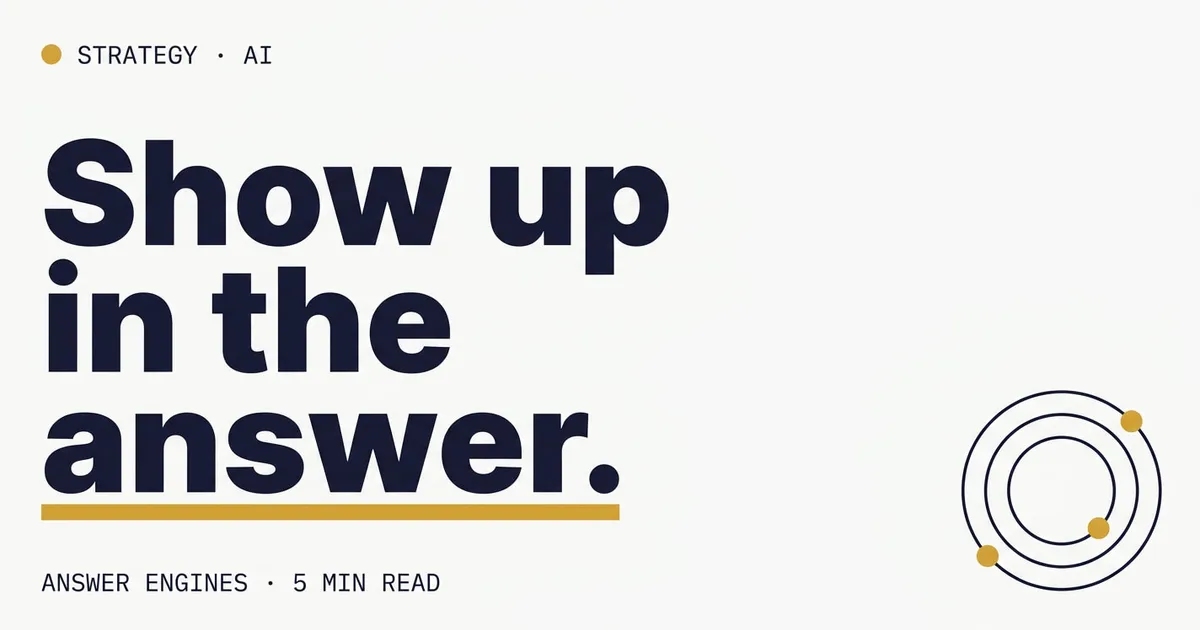
Most businesses are overcomplicating “AI optimization.” The same things that help humans help AI: clarity, structure, fast pages, and direct language.
TL;DR
You don’t need an “AI layer” (llms.txt, AI widgets, GEO/AEO tricks). Google’s May 2026 guidance pushes against that. What works: clean HTML, direct answers at the top of each section, and content that plainly states who you are, what you do, and where you operate.
Many AI crawlers still choke on heavy JavaScript, so your site’s architecture matters more than people expect. Ask yourself three things:
- Can a machine quickly understand my business, services, and audience?
- Can it extract the key facts without running complex JavaScript?
- Is the page clear enough that an AI would confidently cite it?
This isn’t a new “AI strategy.” It’s good technical SEO and clear writing.
Introduction: How AI Search Is Changing How People Find Websites
People are getting more of their answers from AI tools that summarize the web instead of linking to it.
I want to be direct about where this is going, because a lot of businesses are spending money in the wrong place. They treat AI search as a brand-new discipline that needs its own tactics. It isn’t. Tools like ChatGPT, Google AI Overviews, and similar experiences explain, compare, and recommend businesses in plain language, and the way to show up in them is mostly the work you should already be doing.
According to research compiled by Semrush, AI-driven search usage is growing quickly and, on current trajectories, could rival traditional Google search within a few years as more users rely on AI to research products and services.
AI tools don’t show results the same way Google does. Instead of ranking ten websites, they pull information from multiple sources and generate a single answer. Because of that, the type of content AI prefers is different. The same Semrush research found that listicles and comparison pages account for 32.9% of all AI citations, making them the most commonly referenced format.
For small businesses, this shift can actually be an advantage. While AI-driven traffic is usually lower in volume, it tends to be much more qualified. Microsoft Clarity research shows that traffic coming from AI tools can convert up to three times better than traditional organic search. A separate Superprompt analysis found even higher conversion rates in some industries.
Another important change is where AI gets its information. Community platforms like Reddit and Quora are now cited more often than many traditional marketing blogs because they reflect real experiences. An overview published by Visual Capitalist shows Reddit as one of the most cited sources across major AI models.
This guide explains, in simple terms, how to optimize your website for AI search in 2026. It’s written for small business owners and decision-makers who want to stay visible as search evolves, without needing to become SEO experts.
This isn’t just my opinion. In May 2026, Google published an official AI optimization guide confirming that strong SEO fundamentals, not separate “AI hacks,” are what makes a site eligible for AI Overviews and AI Mode. This article reflects that guidance.
In 2026, being “found” online increasingly means being understood and cited by AI, not just ranking on Google. The good news: you get there by doing the fundamentals well, not by chasing a new playbook.
What Is Generative Engine Optimization (GEO)?
Generative Engine Optimization (GEO) means optimizing your website so AI tools can understand your content, extract useful sections, and cite them when generating answers.
Put simply, GEO helps your business appear inside AI-generated answers, not just in search results.
How GEO Differs from Traditional SEO
Traditional SEO focuses on ranking higher on Google and driving clicks.
GEO focuses on clarity, structure, and trust so AI systems can reuse your content as a source.
Instead of asking “Where does my page rank?”, GEO asks:
”Is my content clear and useful enough for AI to reuse it?”
Google’s official position (May 2026): Google now states plainly that optimizing for generative AI search is SEO, and recommends prioritizing effective SEO strategies over “AEO/GEO hacks.” I use the term “GEO” below as a useful lens for content decisions, not as a separate discipline you need to staff or budget for.
Why Traditional SEO Still Powers AI Search
AI search tools use a process called Retrieval-Augmented Generation (RAG). In plain terms, before an AI tool can answer a question about your business, it first searches a search engine’s index to find relevant pages. If your site isn’t indexed and visible, it can’t be cited.
Search Engine Index → AI Retrieval → Generated Answer
This means SEO is the foundation of AI search, not a separate discipline. Google confirms that its AI products (including AI Overviews and Gemini) are built on Google Search. Lily Ray’s research documents that ChatGPT increasingly relies on Google’s index for retrieval too. Undermining your organic rankings is one of the most damaging things you can do to your AI search presence.
Entities, Not Just Keywords
AI tools don’t just read words. They map your content as a network of connected entities (your brand, your services, your team, your products, your locations). Stating those relationships clearly (“Oui Digital builds websites for small businesses in San Diego”) makes it easier for AI systems to understand who you are, what you do, and who you do it for, which is what earns citations.
This is one of the foundations of modern search engine optimization: helping both people and machines see your business as a coherent, trustworthy entity.
How to Strengthen Your Entity Signals
Link your About page and author bios to verifiable profiles such as LinkedIn and professional directories. Use consistent Organization and ProfilePage schema markup so search engines and AI tools can confirm who is behind your content. Make sure your business name, services, and location appear consistently across your site and external profiles. Google’s people-first content guidance emphasizes demonstrating who created the content and why they should be trusted: exactly the kind of signal AI tools use when deciding what to cite.
Why “SEO for AI” Is the Clearest Way to Explain This
“SEO for AI” keeps things simple for non-technical audiences. It reinforces that SEO fundamentals still matter, but visibility now extends beyond Google into AI-powered search experiences.
How AI Systems Read and Extract Content
AI systems do not read websites like humans do. They extract small, self-contained sections that directly answer questions.
Research from Ahrefs found that over 90% of pages cited by ChatGPT are not even in Google’s top 20 results, proving that AI does not rely only on rankings. However, this doesn’t mean rankings are irrelevant. Most AI tools still need your content to be indexed and visible in a search engine before they can cite it. Recent research shows ChatGPT increasingly relies on Google’s index for retrieval, making organic visibility foundational to AI search performance.
How AI Extracts Sections (and What That Means for You)
Helpful structure for humans is what serves AI extraction too:
- One clear idea per paragraph
- Each paragraph reads naturally on its own
- The first sentence of each section states the answer
- Headings reflect real questions readers ask
Google’s official guidance is clear: there’s no required word count, no minimum section length, and no need to chop content into “AI-friendly chunks.” Front-load the direct answer in the first sentence of every section. AI extraction doesn’t wait for paragraph three. Use direct questions as headers and clear answers as opening sentences. The original GEO research found that content with clear structure, statistics, and direct answers earned significantly more AI citations.
Structuring Headings for AI Extraction
Headings should reflect real questions people ask, followed immediately by direct answers.
Writing Patterns That Help AI (and Humans)
Clear writing helps everyone:
- Short sentences
- Simple words
- Consistent terminology
- No vague references
Not sure if AI can understand your website? Request a website audit to see how readable your content is for modern AI tools.
SEO vs AEO vs GEO: Which One Matters Most in 2026?
All three labels describe the same work aimed at different formats. Google now treats them as facets of SEO, not distinct disciplines, so don’t let the acronyms convince you to run three separate workstreams. The table below is a planning lens to decide where a given page should focus, nothing more.
When Traditional SEO Still Wins
Local searches, service pages, and branded searches still rely heavily on classic SEO.
When Answer Engine Optimization (AEO) Works Best
AEO helps with “what is” and “how to” questions, FAQs, and featured snippets.
When GEO Has the Biggest Impact
GEO is most effective for comparisons, lists, in-depth guides, and data-driven content.
| Strategy | Main Goal | Best For | Where You Appear |
|---|---|---|---|
| SEO | Rankings & traffic | Local and service searches | |
| AEO | Direct answers | FAQs and definitions | Snippets & AI summaries |
| GEO | AI citations | Comparisons and guides | AI tools |
Why Authority and Mentions Matter More Than Backlinks
AI tools infer trust from who mentions you and where, not just from backlinks.
An analysis by Visual Capitalist shows Reddit as one of the most cited sources across AI platforms.
What Co-Citations Mean
If your business is mentioned alongside trusted brands, AI assumes relevance and credibility.
How to Earn Mentions
Participate in comparisons, answer real questions on community platforms, and publish original insights. Reddit threads and YouTube video transcripts are especially influential, since both are heavily used to train and ground AI models. Encouraging people to search for your brand by name also reinforces authority signals that AI tools pick up on.
Important: Google explicitly warns against seeking inauthentic mentions across the web. Astroturfed Reddit posts, paid “mentions,” or coordinated brand-name campaigns can backfire. Genuine participation in real conversations is what builds the kind of authority AI tools reward.
Why This Is Good News for Small Businesses
An analysis of 400+ websites found that Google now rewards what AI can’t easily replicate: real products and services, tight topical focus, proprietary assets, and strong brands. Sites offering a real service outperformed informational-only sites by a wide margin. In plain terms: if you’re a plumber in San Diego or a wedding photographer in Austin, you already have what Google and AI tools value most: real expertise, a real service, and a focused niche. You don’t need to compete with content farms. Focus on what makes your business genuinely useful.
Conversational Queries and Topical Depth
People speak to AI like a person.
According to Semrush research, 77% of ChatGPT users already use it like a search engine.
From Keywords to Questions
Modern queries are longer, more specific, and context-rich.
Why Topical Depth Matters
Deep, focused content on the topics you actually serve gives AI systems richer context to draw from. Google notes you don’t need to chase artificial “long-tail keyword” lists. A thorough page about what you genuinely do is more useful than dozens of thin variants.
Technical SEO Still Matters (But for AI Crawlers)
This is the part most “AI optimization” advice skips, and it’s where I see the biggest gap. If an AI crawler can’t read your site’s code, none of your content matters. It can’t cite what it can’t parse.
A study by SearchVIU found that most AI crawlers cannot reliably execute JavaScript. A page that needs JavaScript to render its main content is often a blank page to these tools. Clean, server-rendered HTML isn’t a nice-to-have here; it’s the difference between being readable and being invisible. This is exactly why your underlying architecture matters more than any AI widget you could bolt on top.
Schema markup isn’t required for AI search. Google has confirmed there’s no special structured data you need to add. But it remains a valuable part of overall SEO: it helps confirm what your page is about, supports rich results, and gives both search engines and AI systems an unambiguous read of your business identity. Google’s structured data documentation outlines the most relevant types:
- Article for blog posts and guides
- Organization for business identity
- ProfilePage for author credibility
- VideoObject if publishing video content
A note on FAQPage schema (updated May 2026): Google deprecated FAQ rich results on May 7, 2026 and is sunsetting the related Search Console report in June 2026. We no longer recommend adding FAQPage JSON-LD. Keep FAQ sections as readable HTML. AI tools still extract the visible Q&A, but skip the structured-data wrapper.
You can validate your remaining markup with Google’s Rich Results Test to make sure it’s working correctly.
Why Bing Indexing Matters for ChatGPT
As explained by Search Engine Land, many AI tools rely heavily on Bing’s index to discover content. A Seer Interactive study found that 87% of ChatGPT citations match Bing’s top 10 organic results. Submit your sitemap to Bing Webmaster Tools. Bing now offers an AI Performance report showing how your pages are cited in Copilot and ChatGPT. Make sure your robots.txt doesn’t block AI crawlers. OpenAI’s publisher documentation confirms that public sites appear in ChatGPT search as long as OAI-SearchBot is not blocked.
Why Citation Behavior Differs by Platform
Each AI tool cites differently. Research shows that only 11% of domains appear in both ChatGPT and Perplexity results. Perplexity tends to favor smaller, specialized sources, which is encouraging for niche small businesses. Google AI Overviews pull from Google’s own index, rewarding traditional SEO fundamentals. The takeaway: optimize for clarity and structure, and you’ll perform well across platforms, but don’t assume visibility in one means visibility in all.
| Platform | What It Uses | How to Get Cited | How to Track |
|---|---|---|---|
| Google AI Overviews | Google Search index | Strong organic rankings + structured content | Google Search Console |
| ChatGPT | Web retrieval; Bing visibility and OAI-SearchBot access both matter | Bing rankings + allow OAI-SearchBot | Bing AI Performance report + utm_source=chatgpt.com |
| Perplexity | Own index (200B+ URLs) | Niche expertise + fresh, structured content | GA4 referrals from perplexity.ai |
What’s Coming: Query Fan-Out, AI Mode, and Agentic Experiences
Google’s May 2026 guide formally introduces three concepts small businesses should understand.
Query Fan-Out
When a user asks a complex question in AI search, Google’s systems generate multiple related sub-queries behind the scenes, a process Google calls “query fan-out.” A single user question can trigger several searches across your topic area. Pages that cleanly answer specific sub-questions (not just the broad query) are more likely to be pulled in.
AI Mode
AI Mode is a more conversational, multi-turn search experience distinct from AI Overviews. To be eligible, Google explicitly requires that a page be indexed and eligible to appear in Google Search with a snippet. If you’ve been blocked from search results, you’re blocked from AI Mode too.
Agentic Experiences
Google is rolling out AI agents that don’t just summarize. They take actions on behalf of users (booking, comparing, transacting). For service businesses, accurate, machine-readable information about your services, hours, prices, and booking options will increasingly determine whether an AI agent can recommend or transact with your business. Google specifically points to Merchant Center and the Business Agent for businesses that want to participate in these agentic experiences.
Freshness and Information Gain in AI Search
AI prefers newer, original insights.
Ahrefs analysis shows that AI-cited content is significantly fresher than traditional search results.
What Information Gain Means
AI favors content that adds something new: frameworks, examples, or original data.
When updating existing content, make sure the changes are genuinely meaningful, not just cosmetic. Google recommends using clear visible dates (labeled “Published” or “Updated”), and keeping structured data dates consistent with what visitors see on the page. Updating a publish date without substantive changes can undermine trust signals and may not help visibility.
The Content Formats AI Cites Most
Listicles and Comparisons
Listicles and comparisons account for 32.9% of AI citations.
Tables and Structured Content
Tables are easy for AI to extract and reuse.
Data and Statistics
Pages with real numbers are cited more often, as shown in academic GEO research.
Video and Transcripts
Short expert videos with transcripts give AI tools another source to extract from. Google’s video structured data documentation supports discoverability when VideoObject markup and accessible on-page context are provided. For small businesses, even a 2–3 minute explainer video on a key service page can create a citation opportunity that text-only competitors miss. When you embed those videos, use clean, responsive markup; our responsive embed code generator produces valid HTML5 embeds that support VideoObject schema across devices.
How to Measure SEO Success in an AI-Driven World
AI traffic is smaller, but far more valuable.
Microsoft Clarity and Superprompt both show AI-referred traffic converting 3–5× higher than traditional organic traffic.
Here’s how to track AI search performance in practice:
- Bing Webmaster Tools AI Performance: shows when your pages are cited in AI-generated answers across Copilot and partner experiences (Bing Webmaster Tools)
- ChatGPT referral tracking: OpenAI’s publisher FAQ confirms traffic from ChatGPT appears with utm_source=chatgpt.com in your analytics
- Manual brand-query checks: search for your business name and key services in ChatGPT, Gemini, and Perplexity monthly to see how you’re being described
- AI-referred conversion quality: track whether leads from AI referrals convert differently (the Microsoft Clarity and Superprompt data above supports this)
Inaccurate AI citations can spread across platforms. Publishing clear, well-structured brand content on your own site is the best way to correct the record.
A Practical SEO-for-AI Checklist
- Write clear, stand-alone paragraphs
- Publish comparisons and lists
- Earn mentions, not just links
- Add Organization and ProfilePage schema markup (Google deprecated FAQPage rich results on May 7, 2026; skip that one)
- Make your brand → service → location relationships explicit
- Refresh content regularly
- Track visibility beyond Google
- Ensure your site is indexed in both Google and Bing
- Don’t block AI crawlers (OAI-SearchBot, PerplexityBot) in robots.txt
- Offer real services or tools that help visitors complete a task
- Own something AI can’t replicate (original data, unique insights, real experience)
- Monitor what AI tools say about your business regularly
- Confirm your key pages are indexed in Google Search (a prerequisite for AI Overviews and AI Mode eligibility)
- If you sell products or take bookings, check that your information is accurate and machine-readable for AI agents (consider Merchant Center where relevant)
Common Mistakes to Avoid
Optimizing for AI search doesn’t require shortcuts, and the shortcuts tend to backfire. Almost every mistake I see comes from treating AI as a separate game with its own rules.
Scaling low-quality content at volume: Google’s AI content guidance is clear: AI-generated content that doesn’t add original value falls under existing spam policies.
Artificially refreshing dates: Google recommends that dates reflect genuinely meaningful updates, not cosmetic changes.
Excessive self-promotional listicles: Lily Ray’s research documents Google cracking down on sites that heavily use this pattern.
Chasing “AI hacks” over fundamentals: This is the big one. Google’s May 2026 guide explicitly warns against prioritizing “AEO/GEO hacks” or seeking inauthentic mentions over solid SEO. The “AI layer” tactics people are selling right now, like LLMs.txt files, AI-targeted keyword stuffing, or astroturfed brand mentions, aren’t recommended and may harm your standing. They’re effort spent in the wrong place while the fundamentals go ignored.
Thoughtful, expert-led content workflows are fine. The risk comes from mass-scaled, manipulative tactics designed to game the system rather than serve readers.
Conclusion: This Is a Return to Fundamentals
Search now happens across AI tools, not just Google. That sounds like it should change everything. In practice, it changes less than the hype suggests.
GEO doesn’t replace SEO. It expands where the same work pays off. The businesses that win in AI search are the ones that make it easy for a machine to understand who they are, what they do, and where they operate, then serve that up in clean HTML with the answer near the top of every section.
So if you take one thing from this guide: don’t build an “AI layer.” Fix the foundation. Clear writing, clean code, and a site that plainly explains your business will do more for your AI visibility than any tactic with an acronym.
Structure, clarity, and authority define visibility in 2026. As Google’s own May 2026 guidance confirms, that’s not “AI optimization.” It’s good technical SEO and clear communication, applied honestly.
Want to know if your website is AI-readable? Request a website audit and see how your content performs in modern AI search.
Explore more SEO insights in our SEO insights hub.